Kölner Stadtanzeiger & Kölnische Rundschau
Smartphone Sets Tempo in Rehearsal Room
He is an inventor with many talents: technically gifted, musical, and tech-savvy. His latest project brings all of this together. Kilian Günthner has developed an app for musici...
Originally published on:
Originally written by:
Ulla Jürgensonn
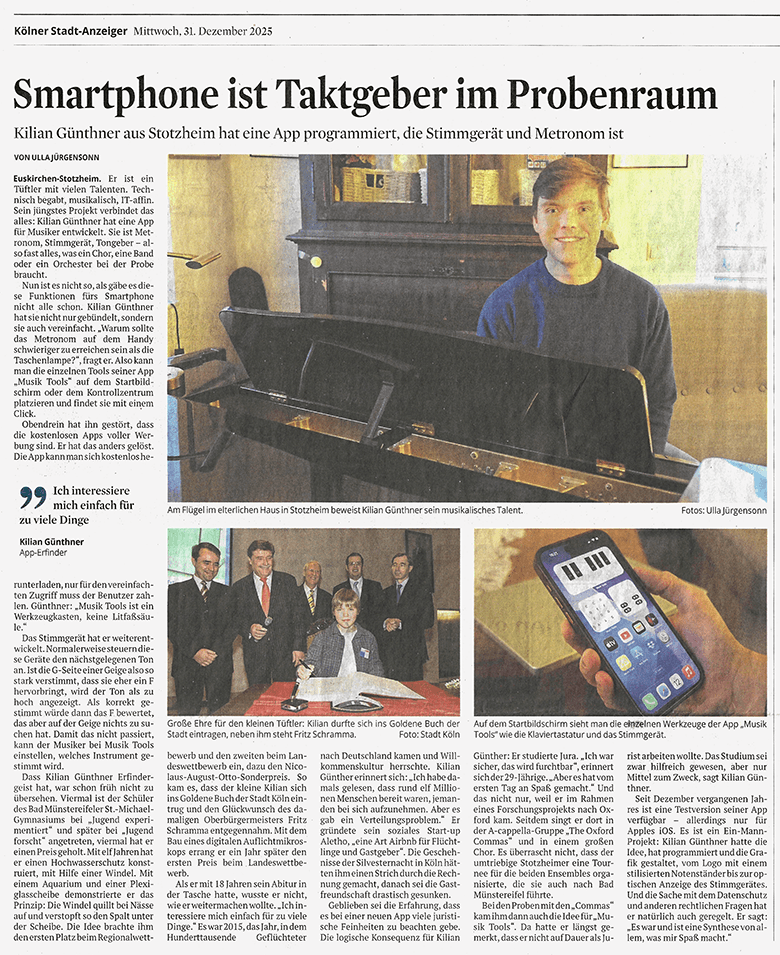
Original Article:
Translation (English):
Teaser
Music Tools: A 29-year-old inventor from Stotzheim has developed an all-in-one app for musicians. → Page 29.
Kilian Günthner from Stotzheim has developed an app that’s both tuner and metronome
BY ULLA JÜRGENSONN
Euskirchen-Stotzheim. He is a tinkerer with many talents: technically gifted, musical, and tech-savvy. His latest project brings all of this together. Kilian Günthner has developed an app for musicians. It functions as a metronome, tuner, pitch generator – in other words, almost everything a choir, a band, or an orchestra needs for rehearsal.
It’s not as if these functions don’t already exist individually on smartphones. But Kilian Günthner has done more than just bundle them together, he has simplified them. “Why should the metronome on your phone be harder to access than the flashlight?” he asks. As a result, the individual tools in his app “Music Tools” can be placed on the home screen or in the control center and accessed with a single tap.
In addition, he was bothered by the fact that free apps are often full of advertising. He chose a different approach. The app itself can be downloaded for free; users only have to pay for the simplified, direct access. Günthner says: “Music Tools is a toolbox, not a billboard.”
He also improved on the tuner. Normally, these devices lock onto the nearest pitch. If, for example, a violin’s G string is so badly out of tune that it produces something closer to an F, a regular tuning device will display the pitch as too high. An even lower F would then be considered “correctly tuned,” even though it doesn’t belong on the violin at all. To prevent this, Music Tools allows musicians to specify which instrument is being tuned.
Kilian Günthner’s inventive spirit was evident early on. As a student at St. Michael’s Gymnasium in Bad Münstereifel, he participated four times in the competitions “Jugend experimentiert” and later “Jugend forscht” – and won a prize every time. At the age of eleven, he designed a flood-protection device with the help of diapers. Using an aquarium and a Plexiglas pane, he demonstrated the principle: when wet, the diaper swells and seals the gap beneath the pane. The idea earned him first place at the regional competition and second place at the state level, as well as the Nicolaus August Otto Special Prize. As a result, young Kilian was invited to sign the Golden Book of the City of Cologne and received congratulations from the then-mayor, Fritz Schramma. A year later, he won first prize at the state competition with a digital reflected-light microscope he had built himself.
When he graduated from high school at eighteen, he wasn’t sure how to proceed. “I’m simply interested in too many things,” he says. It was 2015, the year hundreds of thousands of refugees came to Germany and a strong culture of welcome prevailed. Günthner recalls: “At the time, I read that around eleven million people were willing to host someone. But there was a distribution problem.” He founded the social startup Aletho, “a kind of Airbnb for refugees and hosts.” The events of New Year’s Eve in Cologne, however, put an abrupt end to the project; afterward, willingness to host dropped sharply.
What remained was the realization that launching a new app involves many legal intricacies. The logical consequence for Günthner was to study law. “I was sure it would be awful,” the 29-year-old recalls. “But I ended up enjoying it from the very first day.” Not least because he came to Oxford as part of a research project. Since then, he has sung there in the a cappella group “The Oxford Commas” and in a large choir. It comes as no surprise that the energetic Stotzheim native organized a concert tour for both ensembles, which also brought them to Bad Münstereifel.
It was during rehearsals with the “Commas” that the idea for “Music Tools” emerged. By then, Günthner had already realized that he did not want to work as a lawyer long term. The degree was useful, he says, but ultimately a means to an end.
A test version of the app has been available since December of last year – currently only for Apple’s iOS. It is a one-man project: Günthner had the idea, did the programming, and designed the graphics, from the logo featuring a stylized music stand to the visual display of the tuner. He also took care of data protection and other legal matters himself. “It was – and still is – a synthesis of everything I enjoy,” he says.
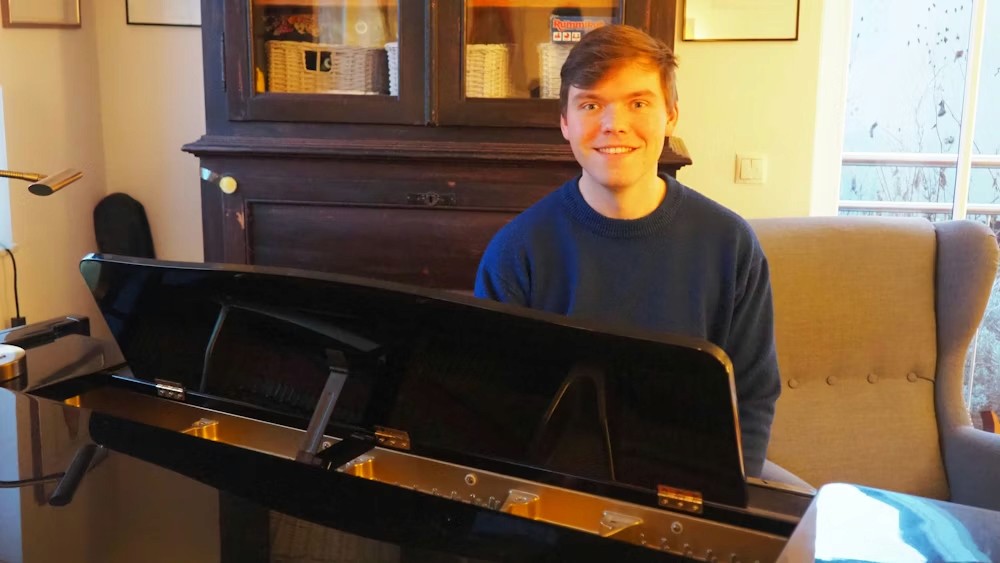
Image Caption 1: At the grand piano in his family home in Stotzheim, Kilian Günthner demonstrates his musical talent. Copyright: Ulla Jürgensonn.
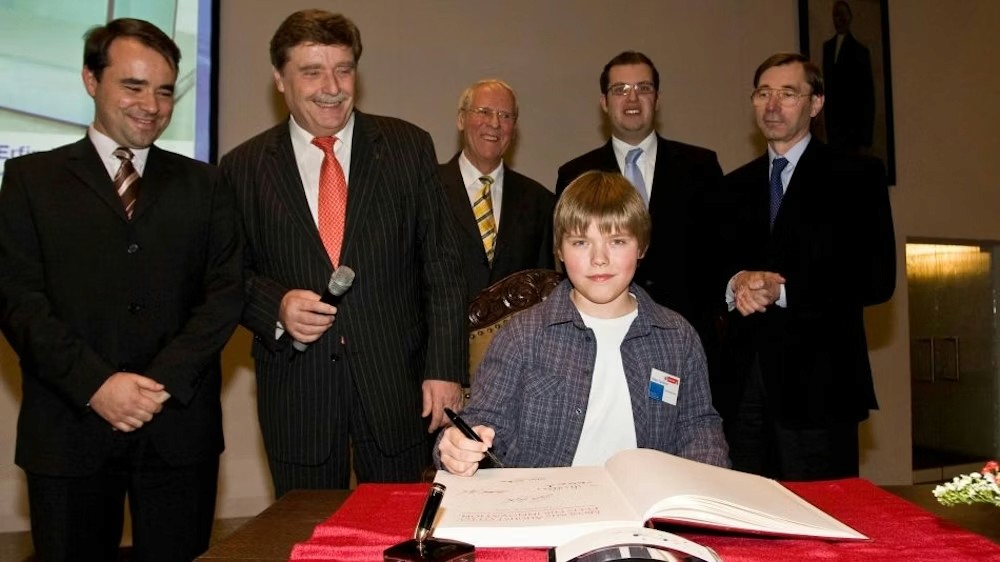
Image Caption 2: A great honor for the young inventor: Kilian was invited to sign the Golden Book of the City, standing next to Fritz Schramma. Copyright: City of Cologne.
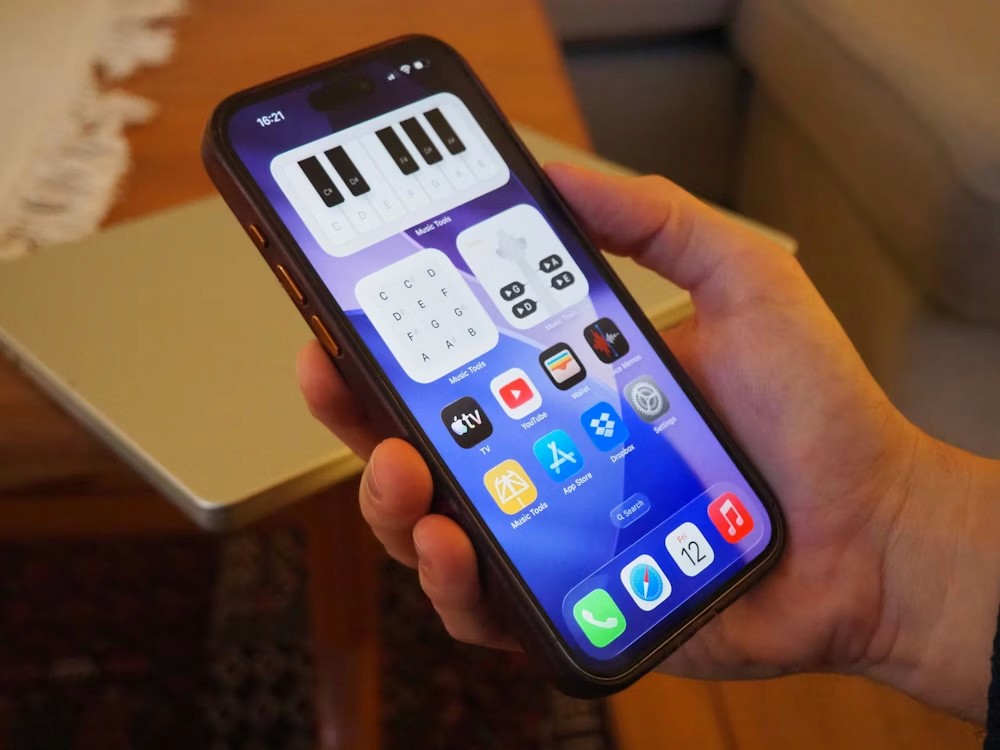
Image Caption 3: The Home Screen shows the individual Music Tools widgets, such as the keyboard and the tuner. Copyright: Ulla Jürgensonn.
This article can also be found online on the websites of Kölner Stadt-Anzeiger and Kölnische Rundschau.
————
Original (German):
Teaser
Musik Tools: 29-jähriger Tüftler aus Stotzheim hat eine Allround-App für Musiker entwickelt. → Seite 29.
Kilian Günthner aus Stotzheim hat eine App programmiert, die Stimmgerät und Metronom ist
VON ULLA JÜRGENSONN
Euskirchen-Stotzheim. Er ist ein Tüftler mit vielen Talenten. Technisch begabt, musikalisch, IT-affin. Sein jüngstes Projekt verbindet das alles: Kilian Günthner hat eine App für Musiker entwickelt. Sie ist Metronom, Stimmgerät, Tongeber – also fast alles, was ein Chor, eine Band oder ein Orchester bei der Probe braucht.
Nun ist es nicht so, als gäbe es diese Funktionen fürs Smartphone nicht alle schon. Kilian Günthner hat sie nicht nur gebündelt, sondern sie auch vereinfacht. „Warum sollte das Metronom auf dem Handy schwieriger zu erreichen sein als die Taschenlampe?“, fragt er. Also kann man die einzelnen Tools seiner App „Musik Tools“ auf dem Startbildschirm oder dem Kontrollzentrum platzieren und findet sie mit einem Click.
Obendrein hat ihn gestört, dass die kostenlosen Apps voller Werbung sind. Er hat das anders gelöst. Die App kann man sich kostenlos herunterladen, nur für den vereinfachten Zugriff muss der Benutzer zahlen. Günthner: „Musik Tools ist ein Werkzeugkasten, keine Litfaßsäule.“
Das Stimmgerät hat er weiterentwickelt. Normalerweise steuern diese Geräte den nächstgelegenen Ton an. Ist die G-Saite einer Geige also so stark verstimmt, dass sie eher ein F hervorbringt, wird der Ton als zu hoch angezeigt. Als korrekt gestimmt würde dann das F bewertet, das aber auf der Geige nichts zu suchen hat. Damit das nicht passiert, kann der Musiker bei Musik Tools einstellen, welches Instrument gestimmt wird.
Dass Kilian Günthner Erfindergeist hat, war schon früh nicht zu übersehen. Viermal ist der Schüler des Bad Münstereifeler St.-Michael-Gymnasiums bei „Jugend experimentiert“ und später bei „Jugend forscht“ angetreten, viermal hat er einen Preis geholt. Mit elf Jahren hat er einen Hochwasserschutz konstruiert, mit Hilfe einer Windel. Mit einem Aquarium und einer Plexiglasscheibe demonstrierte er das Prinzip: Die Windel quillt bei Nässe auf und verstopft so den Spalt unter der Scheibe. Die Idee brachte ihm den ersten Platz beim Regionalwettbewerb und den zweiten beim Landeswettbewerb ein, dazu den Nicolaus-August-Otto-Sonderpreis. So kam es, dass der kleine Kilian sich ins Goldene Buch der Stadt Köln eintrug und den Glückwunsch des damaligen Oberbürgermeisters Fritz Schramma entgegennahm. Mit dem Bau eines digitalen Auflichtmikroskops errang er ein Jahr später den ersten Preis beim Landeswettbewerb.
Als er mit 18 Jahren sein Abitur in der Tasche hatte, wusste er nicht, wie er weitermachen wollte. „Ich interessiere mich einfach für zu viele Dinge.“ Es war 2015, das Jahr, in dem Hunderttausende Geflüchteter nach Deutschland kamen und Willkommenskultur herrschte. Kilian Günthner erinnert sich: „Ich habe damals gelesen, dass rund elf Millionen Menschen bereit waren, jemanden bei sich aufzunehmen. Aber es gab ein Verteilungsproblem.“ Er gründete sein soziales Start-up Aletho, „eine Art Airbnb für Flüchtlinge und Gastgeber“. Die Geschehnisse der Silvesternacht in Köln hätten ihm einen Strich durch die Rechnung gemacht, danach sei die Gastfreundschaft drastisch gesunken.
Geblieben sei die Erfahrung, dass es bei einer neuen App viele juristische Feinheiten zu beachten gebe. Die logische Konsequenz für Kilian Günthner: Er studierte Jura. „Ich war sicher, das wird furchtbar“, erinnert sich der 29-Jährige. „Aber es hat vom ersten Tag an Spaß gemacht.“ Und das nicht nur, weil er im Rahmen eines Forschungsprojekts nach Oxford kam. Seitdem singt er dort in der A-cappella-Gruppe „The Oxford Commas“ und in einem großen Chor. Es überrascht nicht, dass der umtriebige Stotzheimer einer Tournee für die beiden Ensembles organisierte, die sie auch nach Bad Münstereifel führte.
Bei den Proben mit den „Commas“ kam ihm dann auch die Idee für „Musik Tools“. Da hatte er längst gemerkt, dass er nicht auf Dauer als Jurist arbeiten wollte. Das Studium sei zwar hilfreich gewesen, aber nur Mittel zum Zweck, sagt Kilian Günthner.
Seit Dezember vergangenen Jahres ist eine Testversion seiner App verfügbar – allerdings nur für Apples iOS. Es ist ein Ein-Mann-Projekt: Kilian Günthner hatte die Idee, hat programmiert und die Grafik gestaltet, vom Logo mit einem stilisierten Notenständer bis zur optischen Anzeige des Stimmgerätes. Und die Sache mit dem Datenschutz und anderen rechtlichen Fragen hat er natürlich auch geregelt. Er sagt: „Es war und ist eine Synthese von allem, was mir Spaß macht.“
Image Caption 1: Am Flügel im elterlichen Haus in Stotzheim beweist Kilian Günthner sein musikalisches Talent. Copyright: Ulla Jürgensonn.
Image Caption 2: Große Ehre für den kleinen Tüftler: Kilian durfte sich ins Goldene Buch der Stadt eintragen, neben ihm steht Fritz Schramma. Copyright: Stadt Köln.
Image Caption 3: Auf dem Startbildschirm sieht man die einzelnen Werkzeuge der App „Musik Tools“ wie die Klaviertastatur und das Stimmgerät. Copyright: Ulla Jürgensonn.
Dieser Artikel ist auch online auf den Webseiten des Kölner Stadt-Anzeigers und der Kölnischen Rundschau verfügbar.